Rinse and Repeat: The Counties Where Clean Laundry Costs a Half-Day and a Tank of Gas
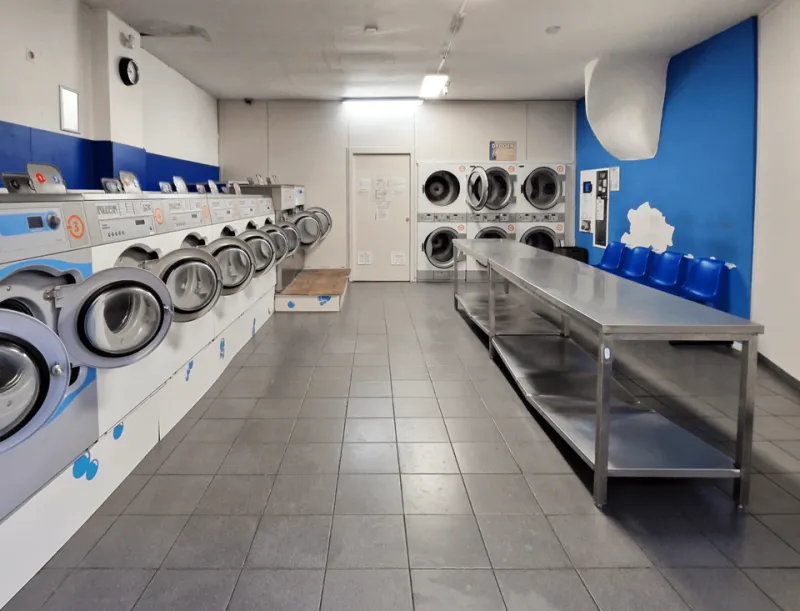
Photo: Renée Kools, CC BY-SA 4.0, via Wikimedia Commons
A washer and dryer are not amenities. In most American homes they function as infrastructure — the reason a work uniform is clean on Monday, a toddler has fresh sheets, and a home-care patient has sterile dressings. When that infrastructure is absent, the need for clean laundry does not disappear. It simply relocates: into a car, onto a bus line, into a coin-operated machine across the county line, or into a bathtub.
Global Awareness Map's laundry-access layer traces that relocation. It asks a narrow question with wide consequences: how far must a household travel, and how much must it spend, to do what a machine in the utility room would otherwise handle in an hour?
County-level counts described here are estimates assembled from public housing, business-registration, and water-rate sources. They should be read as approximations and starting points for local inquiry, not as audits.
What the Map Counts as a Laundry Desert
Three conditions are layered together. The first is the share of occupied housing units without an in-unit washer and dryer — a figure that tracks closely with age of housing stock, rental tenure, manufactured housing, and small multifamily buildings. The second is the density of self-service laundry businesses within a twenty-minute drive. The third is household vehicle availability, because a laundromat without a ride is not access.
Drive time, not distance, drives the map. A machine two miles away across a river with no bridge is farther in practice than ten miles along a grid road. Where all three conditions converge — no machine at home, no reliable vehicle, no nearby laundry — the gap is not an inconvenience. It is a weekly logistical crisis.
Laundry access differs in character from other service deserts. Laundromats follow market signals, and their economics are unforgiving: water, sewer, natural gas, card-processing fees, and real estate. In small towns the math often fails, and when the last machine closes, the nearest alternative may be a county away.
The Housing Half of the Equation
Most discussion of laundry access starts with the business. It should start with the building. A washer and dryer hookup is a plumbing and electrical project, and in older rentals, public housing, and manufactured homes it is frequently absent. Landlords have limited incentive to add hookups when the tenant pays the utility bill and the unit rents anyway. In-unit laundry has become a market differentiator rather than a baseline expectation.
The result is that the households least able to absorb cost and time penalties — renters, older adults, families with young children, people with mobility limitations — are the most likely to be carrying baskets to a commercial machine.
Water and Sewer: The Price of Clean Clothes
A home machine of recent vintage typically uses somewhere in the range of fifteen to twenty gallons per load, and high-efficiency models use less. At a laundromat, the household pays per load, plus drying, and typically pays again in fuel to get there. Households without machines therefore face a volume penalty: the more laundry a family generates, the more expensive each clean load becomes.
Where water and sewer rates in small systems have climbed — increasingly common as aging treatment plants are replaced — that penalty compounds. Some households respond by rationing: washing only the items that can be seen, re-wearing, or postponing bedding and towels. Others use bathtubs and portable machines, which can strain plumbing and produce higher water use than a modern washer would have.
The Clock Is the Other Half of the Cost
Laundromats close. Shift work does not. The last wash cycle at many stores begins in the early evening, which is precisely when a warehouse, hospital, or food-processing worker finishing a swing shift has time to appear. For a household without a car, the trip may require two buses each way, and the store's posted hours may be shorter than the transit system's.
Add children, and the arithmetic turns brutal: a two-hour errand becomes a four-hour outing with supervision, snacks, and waiting. Time poverty is not a metaphor in these households. It is a schedule with no slack in it.
Health Consequences Are Not Hypothetical
Clean textiles are a health input. Skin conditions, respiratory triggers, and infection control all depend on washed bedding, clothing, and towels. Infants, older adults, and people managing incontinence or open wounds are especially exposed. School attendance and workplace appearance carry their own penalties, and in small communities the visibility of a laundry basket in a car trunk can become a source of stigma that families work hard to avoid.
An Action Guide for Local Actors
Planners and economic development staff
Permit small-format laundromats by right in commercial and mixed-use districts, and reduce parking minimums that make small stores infeasible. Where a water or sewer tap fee is the barrier, consider amortizing it over a fixed term. Map existing transit routes against laundry locations before deciding that the market has already answered the question.
Housing authorities and property owners
Include washer and dryer hookups in rehabilitation scopes, particularly for family units and senior housing. Where in-unit machines are impossible, shared laundry rooms with card readers and posted hours beat no option at all. Efficient machines reduce the water and energy bill that often falls back on the operator.
Mutual-aid groups and nonprofits
Laundry voucher pools purchased in bulk from local stores are inexpensive per household and immediate in effect. Volunteer pickup-and-delivery brigades organized through congregations and senior centers serve households that cannot travel at all. Coordinating with school supply closets reduces duplicate spending.
Utilities and water systems
Customer-assistance programs that cover water and sewer, not only electricity, reach households that current energy-focused programs miss. Leak-repair and efficient-appliance programs deliver savings in the same budget line.
What the Layer Cannot Show
Business registrations lag closures and openings. Informal arrangements — a neighbor's machine, a basement setup, a church laundry room — are invisible to any map. The layer is best used to open conversations with housing agencies, transit providers, and store owners, and to test whether the official picture matches what residents describe.
Clean clothes are not a luxury good, and the households carrying this load are not asking for sympathy. They are asking for a shorter trip.