The Notice That Never Expires: Where Boil-Water Warnings Become Routine
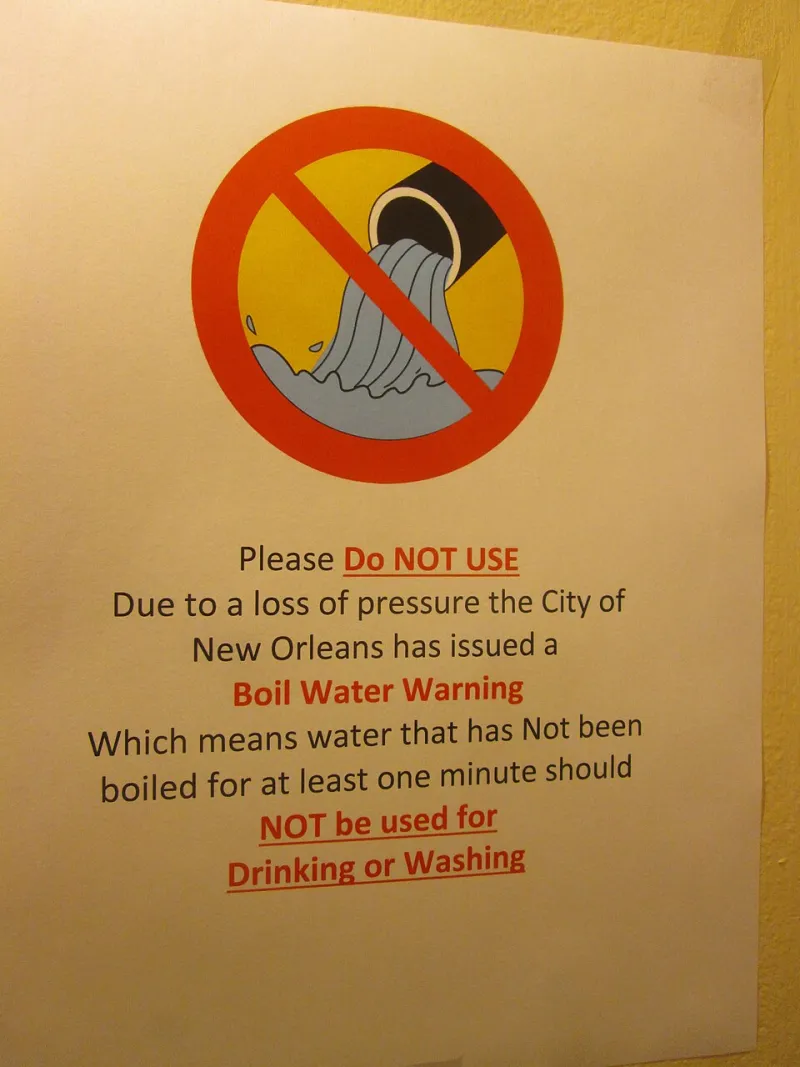
Photo: Infrogmation of New Orleans from New Orleans, CC BY 2.0, via Wikimedia Commons
Turn on the tap in most American kitchens and the water is an afterthought. In a few hundred communities, it is a decision point — a check of the utility's alert page, a glance at the phone, a pot set on the burner before anyone fills a glass.
Boil-water advisories are built as short-lived instruments. A main breaks, pressure drops, contamination becomes theoretically possible, and the utility issues a precautionary notice until sampling confirms the distribution system is clear. In the great majority of places, that is precisely how the episode ends: a day, maybe two, and then normal service resumes. But there is a smaller set of communities where the advisory is less an interruption than a rhythm — where residents can roughly predict, by season or by storm, when the next notice will arrive.
Mapping those places is the purpose of this installment of the Global Awareness Map. The goal is not to alarm residents of every town that has ever issued a notice, but to distinguish the one-off from the structural, and to make visible the pattern that individual households experience only as a series of disconnected annoyances.
What a Boil-Water Notice Actually Confirms
A boil-water advisory is a statement about pressure, not about proven contamination. When a distribution system loses pressure — through a broken main, a pump failure, a power outage at a treatment plant, or a sustained drop in the storage tank level — the hydraulic barrier that keeps soil, groundwater, and bacteria out of the pipes can fail. A notice is issued before test results arrive because the risk window has already opened.
The advisory is therefore a proxy measurement. It tells you that the physical system has been breached, not that pathogens have been detected. Many advisories are lifted without any positive sample. That is a success of the precautionary model — and also the reason repeat advisories matter so much. A community that receives five notices in a decade is not simply unlucky. It is telling you something about the condition of the network beneath the street.
The Anatomy of a Repeat Advisory Community
Across the country, recurring notices tend to share a recognizable profile. Four variables do most of the explanatory work.
Utility age and pipe material. Cast iron and unlined steel mains from the mid-twentieth century are more fracture-prone, and older systems often lack the redundant loops that let operators isolate a break without depressurizing an entire service area. Where distribution maps are incomplete — a common condition in small utilities — crews must guess at valve locations, extending the low-pressure window.
Population size and rate base. Roughly nine in ten U.S. community water systems serve fewer than 3,300 people. These utilities carry the same regulatory obligations as a metropolitan department with a fraction of the revenue and, frequently, a single certified operator who is also the field crew. Capital replacement is deferred not out of neglect but out of arithmetic.
Treatment configuration. Systems dependent on a single source — one wellfield, one intake, one treatment train — have no fallback when that source is compromised. Redundancy is expensive, and it is the first thing a small rate base cannot afford.
Demographic strain. Repeat-notice clusters disproportionately overlap with communities that have higher rates of poverty, older housing stock, and larger renter populations. The correlation is not accidental: deferred infrastructure investment follows low assessed value, and low assessed value follows disinvestment.
Why Small Systems Fail Differently
A metropolitan utility that loses pressure for six hours makes the evening news. A rural water district that loses pressure for six hours issues a notice to 900 connections and hopes everyone sees it. Scale changes the mechanics of both the failure and the warning.
Small systems also face a compounding problem in the labor market. The certified operator workforce is aging, and the pipeline of replacements is thin, particularly in places where the salary for a licensed operator cannot compete with nearby industry. A utility that cannot reliably staff its treatment plant is a utility that will issue more notices — not because its water is worse, but because its margin for error is narrower.
The People Who Never See the Notice
Advisory compliance assumes a household that receives the alert, understands it, has a working stove, and can afford the energy to boil water for drinking, cooking, brushing teeth, and infant formula. Each of those assumptions fails somewhere.
Renters are a particular gap. Notices are typically delivered to the account holder — the landlord — through mail, email, or a utility app. In multifamily buildings, the person drinking the water is frequently not the person receiving the message. Language access is a second gap: many utilities issue notices in English only, in counties where a substantial share of residents speak another language at home. A third is the practical one — boiling water for a family of five for three days is a real cost in both time and electricity.
An Action Guide for Households, Renters, and Advocates
For households
Register for your utility's alert system directly, even if your landlord pays the bill. Most utilities allow any service address to receive notifications. Keep a small stock of bottled water sized to your household — the CDC's general guidance is one gallon per person per day for drinking and sanitation — and know which fixtures are safe for handwashing during an advisory (generally yes, with soap) versus which require boiled or bottled water (drinking, cooking, ice, infant formula, and pets' bowls).
For renters
Ask your landlord, in writing, how water notices are distributed to tenants. If the answer is vague, request that the utility add your unit as a secondary contact. For buildings with multiple units, a posted notice in a common area is a reasonable accommodation to request.
For local advocates
Request the utility's annual consumer confidence report and its most recent sanitary survey — a regulatory document that flags deficiencies in the distribution system. Ask how many boil-water advisories the system issued in the past five years and what share of them followed a main break. Those two questions, asked at a public meeting, convert a scattered series of inconveniences into a documented pattern. Pattern is the language that funding programs understand.
Reading Your Own Map
The value of a national map of repeat advisories is not the ranking it produces. It is the reframing it allows: a boil-water notice is not weather. It is a readout from an engineered system, and engineered systems can be maintained, consolidated, or funded — but only once someone counts the notices.