Ninety Minutes to a Signature: How Distance Turns a Protective Order Into a Logistics Problem
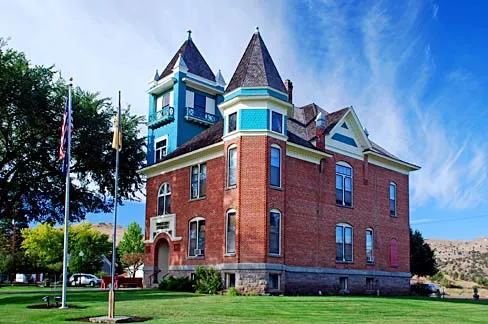
Photo: Gary Halvorson, Oregon State Archives, Attribution, via Wikimedia Commons
The paperwork is not complicated. In most states a petitioner can file for a protective order using a form that fits on a clipboard, and a judge can issue a temporary order the same day. What is complicated is getting the form, finding someone to help complete it, appearing before a judge who is in session, and returning for the hearing two weeks later — all while remaining safe, employed, and out of sight of the person the order is meant to restrain.
Global Awareness Map's protective-order access layer measures that sequence as a geography. For each county it estimates drive time to the nearest courthouse with jurisdiction over protective orders, the nearest legal-aid or advocacy office that assists with filings, and the nearest shelter or safe-housing program. The three are rarely in the same place. In a substantial share of rural counties, they are not in the same county.
The Filing Desk Is Not Where the Danger Is
A survivor who has decided to file has usually made that decision at the end of a long calculation about money, children, and risk. The window in which she will follow through is narrow. Every additional mile, every additional office, and every additional hour of lost wages widens the gap between the decision and the signature.
Distance is not simply inconvenient; it is a filter. Counties where the courthouse is more than an hour's drive from the population center effectively require a full day off work, a reliable vehicle, fuel, and someone to watch children. For households without any of those, the order is available in law and unavailable in practice.
What the Map Measures
The layer is built from court jurisdiction boundaries, public legal-aid service areas, and shelter locations, then combined with road-network drive times rather than straight-line distance. Mountainous terrain, seasonal road closures, and river crossings with no nearby bridges produce some of the sharpest disparities in the country: a county seat that looks close on a highway map can be ninety minutes away in winter.
The layer also flags counties where the only assistance available is by telephone during business hours — a meaningful service, but not one that helps a caller with no reliable phone and no private place to use it.
Court Hours Versus Shift Schedules
Protective-order filings are typically accepted during standard business hours. That schedule presumes a petitioner with weekday flexibility and a job that permits absences. It fits poorly with the shift patterns common in rural manufacturing, agriculture, food processing, and health care — the very sectors that dominate the counties with the longest drive times.
Some jurisdictions have responded with dedicated domestic-violence dockets, remote appearance options, and extended filing hours. Others have consolidated specialized staff into regional hubs, which improves expertise but lengthens travel for the counties outside the hub.
Broadband, E-Filing, and the Paper Gap
Electronic filing is often described as the solution to distance. It is a solution for petitioners with a device, a connection, a scanner, and privacy. Rural and tribal communities with limited broadband, limited cell service, and shared housing do not have those conditions reliably.
Court technology investments therefore need a counterpart: kiosks at libraries and community centers, assisted-filing staff, and telephone or video hearings that do not require a petitioner to appear in a building where the respondent's family also appears.
Safety Planning Is a Route Problem
Advocates describe a pattern that maps do not capture: the courthouse is also the place where a survivor may encounter the respondent, his relatives, or a shared social circle. In small communities, a shelter three counties away can be safer than a courthouse fifteen minutes away — but only if the survivor can get there, park without being seen, and return home without being followed.
That means access is not simply a matter of shortening drives. It requires thinking about waiting rooms, staggered arrival times, security escorts, and the routes between each point in the sequence.
A Reform Agenda
For courts
- Allow filing by sworn written statement and remote notarization where state law permits, with a clear path to a hearing.
- Schedule at least one evening or weekend filing window per month in rural districts.
- Provide separate entrances and waiting areas for petitioners, and coordinate arrival times to reduce contact.
- Publish accurate, plain-language county-level information about where and when filings are accepted, updated whenever a location or hour changes.
For legal-aid and advocacy organizations
- Deploy circuit-riding staff and mobile intake units at predictable locations — libraries, health clinics, tribal offices.
- Train non-lawyer navigators at existing community institutions to assist with forms and referrals.
- Negotiate standing agreements with courts so navigators can confirm filings without a second trip.
For state legislatures and funders
- Fund travel assistance and childcare for petitioners required to appear in person.
- Treat interpreter access and phone access as core infrastructure, not add-ons.
- Require that any court consolidation study report the change in drive time for the furthest county, not the average.
The Measure That Matters
The relevant statistic is not the number of protective orders a state can issue. It is the number a survivor in the most remote county can actually obtain within a week of needing one. Until that number is close to the legal promise, the right remains paper.